South Africa’s National Student Financial Aid Scheme (NSFAS) is a government understudy monetary guide program that helps college students pay for the costs of their postsecondary education after high …
Almost everywhere in the world saw a rise in life expectancy throughout the twentieth century . The HIV epidemic, which erupted in southern Africa in the late 1980s and early 1990s, caused a sharp spike in mortality among adults of working age . In Swaziland, the life expectancy at the age of fifteen dropped from 68.1 to 53.4 years, while in South Africa it dropped from 67.4 years in 1990 to 58.7 years in 2009. There was also a significant impact on households, communities, and governments as a result of the drop in adult life expectancy: a decrease in household wealth, a rise in the number of children left without parents, the exodus of professionals like teachers and doctors, as well as a break in the transmission of knowledge and norms across generations. Antiretroviral therapy (ART) for HIV began to be widely distributed throughout southern Africa in the early 2000s, frequently with the help of international donors. ART is a medicine cocktail that prevents HIV from replicating, boosts the immune system, and increases the lifespan of persons living with HIV . In South Africa, Malawi , and other countries receiving US government funding for HIV programs, population-level decreases in HIV-related and all-cause death have been recorded . ART’s effect on adult life expectancy in hard-hit communities has yet to be studied at the population level. The term “life expectancy” refers to the average number of years that a person will live, and it is frequently used to compare mortality rates between different groups and through time . Governments, funders, and individuals whose plans for the future will be influenced by changes in the predicted length of life are all interested in adult life expectancy because HIV mostly affects working-age adults. For example, the average lifespan of a 15-year-old is defined as the average number of years an individual can anticipate to live if they are subjected to a population’s age-specific mortality rates throughout time. Adult life expectancy cannot be used to predict the average age at which a cohort will die, because future mortality rates are uncertain, with the exception of the rare circumstance where age-specific mortality rates remain constant in the future. People’s mortality experiences are summarized by life expectancy, and this is the best way to think about it. For HIV-infected adults in South Africa, government clinics and hospitals began providing ART in 2004 to achieve universal coverage for those who fulfill disease-stage eligibility criteria. Since its inception in September 2004, the HIV treatment program run by the African Centre for Disease Control has seen an influx of patients. Nurses at community-based health centers are in charge of administering the program, which is mostly funded by the government. Funding for this initiative has been provided by the President’s Emergency Plan for AIDS Relief from its launch by the Africa Centre (27). About a quarter of all HIV-infected adults in this town were receiving care from the public sector HIV treatment program as of July 1, 2011, 12.6 percent of persons ages 15–49. There has never been much use of antiretroviral medications in the private sector in this region due to the prohibitively high price tag. One of the biggest changes in HIV treatment options occurred when the public sector began to increase the use of antiretroviral therapy (ART). Analysis of trends in adult life expectancy before and after ART became available in the public sector was conducted using a continuous-time approach (28,29). There were different survival curves for each year computed using the Kaplan-Meier estimator (30). The area under the estimated survival curve was used to compute the average life expectancy for adults. Ages >95 years have a dearth of data on which to base single-year estimates of adult life expectancy. Because the oldest cohort member’s age varies with time, we calculated life expectancy between the ages of 15 and 95. 95 …
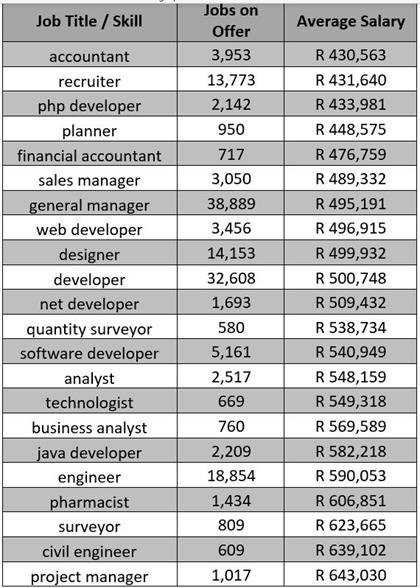
The average salary in South Africa is R 23 526 per month before taxes (or R 282 312 per year). The average monthly earnings paid to employees in the formal non-agricultural sector of …
The official list of the top 10 richest musicians in South Africa 2021, their net worth by Forbes and endorsement deals of these wealthy South African male hip-hop artists …
Sorina Erasmus (born 18 November) is a South African actress, presenter and singer known for her role as Witbank Flooze in the SABC2 soapie 7de Laan. Sorina Erasmus Age …
There are several rich forex traders in South Africa, considering the recent boom to the industry but today we would be ranking the richest traders and the most iconic …
With the FNB Flexi Fixed deposit, you can save over a longer time period. An investment account with a fixed term, while giving you access to a portion of …
It is true that every child has the right to an education. Furthermore, while we all recognize this to be eternal and engraved in the hearts of every parent …
Poultry farming is a very profitable business to start and make money. Poultry Farming in South Africa is probably one of the most lucrative farming business you can do in South Africa …
Gold has been a valuable commodity for thousands of years, and it remains one of the most popular assets to trade on the financial markets. However, trading gold can …